Pages

Sunday, 14 December 2008

Procrastination buster - just a moment, where do I start?

Beating Procrastination

Manage Your Time. Get It All Done.


If you’ve found yourself putting off important tasks over and over again, you’re not alone. In fact, many people procrastinate to some degree - but some are so chronically affected by procrastination that it stops them achieving things they're capable of and disrupts their careers.

The key to controlling and ultimately combating this destructive habit is to recognize when you start procrastinating,  understand why it happens (even to the best of us), and take active steps to better manage your time and outcomes.

Why do we Procrastinate?

In a nutshell, you procrastinate when you put off things that you should be focusing on right now, usually in favor of doing something that is more enjoyable or that you’re more comfortable doing.

Procrastinators work as many hours in the day as other people (and often work longer hours) but they invest their time in the wrong tasks. Sometimes this is simply because they don't understand the difference between urgent tasks and important tasks, and jump straight into getting on with urgent tasks that aren't actually important.

They may feel that they're doing the right thing by reacting fast. Or they may not even think about their approach and simply be driven by the person whose demands are loudest. Either way, by doing this, they have little or no time left for the important tasks, despite the unpleasant outcomes this may bring about.

Another common cause of procrastination is feeling overwhelmed by the task. You may not know where to begin. Or you may doubt that you have the skills or resources you think you need. So you seek comfort in doing tasks you know you're capable of completing. Unfortunately, the big task isn't going to go away – truly important tasks rarely do. 

Other causes of procrastination include:

  • Waiting for the “right” mood or the “right” time to tackle the important task at hand
  • A fear of failure or success
  • Underdeveloped decision making skills
  • Poor organizational skills
  • Perfectionism ("I don't have the right skills or resources to do this perfectly now, so I won't do it at all.")

How to Overcome Procrastination:

Whatever the reason behind procrastination, it must be recognized, dealt with and controlled before you miss opportunities or your career is derailed.

Step 1: Recognize that you're Procrastinating

If you're honest with yourself, you probably know when you're procrastinating.

But to be sure, you first need to make sure you know your priorities. Putting off an unimportant task isn't procrastination, it's probably good prioritization. Use the Action Priority Matrix to identify your priorities, and then work from aPrioritized To Do List on a daily basis.

Some useful indicators which will help you pull yourself up as soon as you start procrastinating include:

  • Filling your day with low priority tasks from your To Do List;
  • Reading an e-mail or request that you've noted in your notebook or on your To Do List more than once, without starting work on it or deciding when you're going to start work on it;
  • Sitting down to start a high-priority task, and almost immediately going off to make a cup of coffee or check your e-mails;
  • Leaving an item on your To Do list for a long time, even though you know it's important;
  • Regularly saying "Yes" to unimportant tasks that others ask you to do, and filling your time with these instead of getting on with the important tasks already on your list.

Step 2: Work out WHY You're Procrastinating

Why you procrastinate can depend on both you and the task. But it's important to understand what the reasons for procrastination are for each situation, so that you can select the best approach for overcoming your reluctance to get going.

Common causes of procrastination were discussed in detail above, but they can often be reduced to two main reasons:

  • You find the task unpleasant; or
  • You find the task overwhelming

Step 3: Get over it!

If you are putting something off because you just don't want to do it, and you really can't delegate the work to someone else, you need to find ways of motivating yourself to get moving. The following approaches can be helpful here:

  • Make up your own rewards. For example, promise yourself a piece of tasty flapjack at lunchtime if you've completed a certain task.

  • Ask someone else to check up on you. Peer pressure works! This is the principle behind slimming and other self-help groups, and it is widely recognized as a highly effective approach.

  • Identify the unpleasant consequences of NOT doing the task.

  • Work out the cost of your time to your employer. As your employers are paying you to do the things that they think are important, you're not delivering value for money if you're not doing those things. Shame yourself into getting going!

If you're putting off starting a project because you find it overwhelming, you need to take a different approach. Here are some tips:

  • Break the project into a set of smaller, more manageable tasks. You may find it helpful to create an action plan.

  • Start with some quick, small tasks if you can, even if these aren't the logical first actions. You'll feel that you're achieving things, and so perhaps the whole project won't be so overwhelming after all.

Key points:

To have a good chance of conquering procrastination, you need to spot straight away that you're doing it. Then, you need to identify why you're procrastinating and taken appropriate steps to overcome the block.

Part of the solution is to develop good time management, organizational and personal effectiveness habits, such as those described in Make Time for Success! This helps you establish the right priorities, and manage your time in such a way that you make the most of the opportunities open to you.

Too many possible actions cloud our thinking. Sort them out wih ...

The Action Priority Matrix
Making the very most of your opportunities

The Action Priority Matrix is a simple diagramming technique that helps you choose which activities to prioritize (and which ones you should drop) if you want to make the most of your time and opportunities.

It’s useful because most of us have many more activities on our “wish lists” – whether these are bright ideas to pursue, exciting opportunities or interesting possibilities – than we have time available. By choosing activities intelligently, you can make the very most of your time and opportunities.

However by choosing badly, you can quickly bog yourself down in low-yield, time-consuming projects that close down opportunities and stop you moving forwards.

How to Use the Tool:

Figure 1 below shows the basic form of the Action Priority Matrix:


The principle behind using the tool is that you score each activity you want to complete on two scales – firstly on the impact the activity will have, and secondly on the effort involved.

By plotting each activity on the Action Priority Matrix using these scores, you can quickly see the projects that give you the greatest returns on your efforts; and adopt the most appropriate approach for that type of activity:

  • Quick Wins (High Impact, Low Effort): These are the most attractive projects, giving you a good return for relatively little effort. Focus on these as much as you can;

  • Major Projects (High Impact, High Effort): While these give good returns, they take a long time to complete – meaning that one “Major Project” can crowd out many “Quick Wins”. If you’re engaging in these, make sure that you complete them quickly and efficiently and that you disengage your effort as soon as you can;

  • Fill Ins (Low Impact, Low Effort): Don’t worry too much about doing these – if you’ve got spare time, do them, but drop them if something better comes along; and

  • Hard Slogs (Low Impact, High Effort): Avoid these. Not only do they give low returns, they crowd out time which would be better used elsewhere.

Tip 1:
Much of the “magic” of this technique comes from understanding and avoiding this crowding out effect.

Tip2:
A variant of this tool is the "Impact-Feasibility Matrix", which substitutes 'Feasibility' for 'Effort' on the horizontal axis. This gives a different perspective, looking at the organization's ability to deliver important changes.


To use the Action Priority Matrix, print off our free worksheet and then follow these steps:

  1. List the activities that you’d like to complete;

  2. Score them on impact (from, say, 0 for no impact to 10 for maximum impact) and on effort involved (from 0, say, for no real effort to 10 for a very major effort);

  3. Plot the activities on the Action Priority Matrix; and

  4. Select or drop activities appropriately.

Tip 3:
Use common sense in interpreting the lines separating the four quadrants – after all, there’s only a small difference between a 4.9 impact activity defined as a “hard slog”, and a 5.1 impact task defined as a “major project”.

Tip 4:
Above we’re suggesting a scale from 0 to 10 for both impact and effort. However there’s nothing stopping you using other scales – for example if you were ranking major projects, you might use $ financial return as the scale on the impact axis, and “man days activity” on the effort axis.


The next tour article offers a Leadership Motivation Assessment – a great tool for helping you understand if you're truly motivated enough to go through the hard work involved in becoming an effective leader. To read this, click 'Next article' below.

I need to do something but I am not sure I have exactly the correct course of action sorted. But I need to act. Tension...


Plan-Do-Check-Act (PDCA)
Implementing new ideas in a controlled way


Something needs to change: Something's wrong, and needs to be fixed, and you've worked hard to create a credible vision of where you want it to be in future. But are you 100% sure that you're right? And are you absolutely certain that your solution will work perfectly, in every way?


Where the consequences of getting things wrong are significant, it often makes sense to run a well-crafted pilot project. That way if the pilot doesn't deliver the results you expected, you get the chance to fix and improve things before you fully commit your reputation and resources.


So how do you make sure that you get this right, not just this time but every time? The solution is to have a process that you follow when you need to make a change or solve a problem; A process that will ensure you plan, test and incorporate feedback before you commit to implementation.


A popular tool for doing just this is the Plan-Do-Check-Act Cycle. This is often referred to as the Deming Cycle or the Deming Wheel after its exponent, W Edwards Deming.


Deming is best known as a pioneer of the quality management approach and for introducing statistical process control techniques for manufacturing to the Japanese, who used them with great success. He believed that a key source of production quality lay in having clearly defined, repeatable processes. And so the PDCA Cycle as an approach to change and problem solving is very much at the heart of Deming’s quality-driven philosophy.


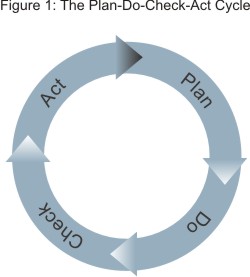
The four phases in the Plan-Do-Check-Act Cycle involve:

  • Plan: Identifying and analyzing the problem;
  • Do: Developing and testing a potential solution;
  • Check: Measuring how effective the test solution was, and analyzing whether it could be improved in any way; and
  • Act: Implementing the improved solution fully.

These are shown in Figure 1 below.


There can be any number of iterations of the “Do” and “Check” phases, as the solution is refined, retested, re-refined and retested again.

How to Use the Tool

The PDCA Cycle encourages you to be methodical in your approach to problem solving and implementing solutions. Follow the steps below every time to ensure you get the highest quality solution possible.


Step 1: Plan
First, identify exactly what your problem is. You may find it useful to use tools like Drill Down, Cause and Effect Diagrams, and the 5 Whys to help you really get to the root of it. Once you’ve done this, it may be appropriate for you to map the process that is at the root of the problem


Next, draw together any other information you need that will help you start sketching out solutions.


Step 2: Do
This phase involves several activities:

  • Generate possible solutions;
  • Select the best of these solutions, perhaps using techniques like Impact Analysis to scrutinize them; and
  • Implement a pilot project on a small scale basis, with a small group, or in a limited geographical area, or using some other trial design appropriate to the nature of your problem, product or initiative.

Our section on Practical Creativity includes several tools that can help you generate ideas and solutions. Our section on Decision Making includes a number of tools that will help you to choose in a scientific and dispassionate way between the various potential solutions you generate.


Note:
The phrase “Plan Do Check Act” or PDCA is easy to remember, but it’s important you are quite clear exactly what “Do” means. “”Do” means “Try” or “Test”. It does not mean “Implement fully.” Full implementation happens in the “Act” phase.


Step 3: Check
In this phase, you measure how effective the pilot solution has been, and gather together any learnings from it that could make it even better.


Depending on the success of the pilot, the number of areas for improvement you have identified, and the scope of the whole initiative, you may decide to repeat the “Do” and “Check” phases, incorporating your additional improvements.


Once you are finally satisfied that the costs would outweigh the benefits of repeating the Do-Check sub-cycle any more, you can move on to the final phase.


Step 4: Act
Now you implement your solution fully. However, your use of the PDCA Cycle doesn’t necessarily stop there. If you are using the PDCA or Deming Wheel as part of a continuous improvement initiative, you need to loop back to the Plan Phase (Step 1), and seek out further areas for improvement.


When to use the Deming Cycle
The Deming Cycle provides a useful, controlled problem solving process. It is particularly effective for:

  • Helping implement Kaizen or Continuous Improvement approaches, when the cycle is repeated again and again as new areas for improvement are sought and solved.
  • Identifying new solutions and improvement to processes that are repeated frequently. In this situation, you will benefit from extra improvements built in to the process many times over once it is implemented.
  • Exploring a range of possible new solutions to problems, and trying them out and improving them in a controlled way before selecting one for full implementation.
  • Avoiding the large scale wastage of resources that comes with full scale implementation of a mediocre or poor solution.

Clearly, use of a Deming Cycle approach is slower and more measured than a straightforward "gung ho" implementation. In true emergency situations, this means that it may not be appropriate (however, it's easy for people to think that situations are more of an emergency than, in reality, they really are...)


Note:
PDCA is closely related to the Spiral Development Approach which is popular in certain areas of software development, especially where the overall system develops incrementally. Spiral Development repeats loops of the PDCA cycle, as developers identify functionality needed, develop it, test it, implement it, and then go back to identify another sub-system of functionality.

Key points:

The Plan-Do-Check-Act (PDCA) Cycle provides a simple but effective approach for problem solving and managing change, ensuring that ideas are appropriately tested before committing to full implementation. It can be used in all sorts of environments from new product development through to marketing, or even politics.


It begins with a Planning phase in which the problem is clearly identified and understood. Potential solutions are then generated and tested on a small scale in the “Do” phase, and the outcome of this testing is evaluated during the Check phase. “Do” and “Check” phases can be iterated as many times as is necessary before the full, polished solution is implemented in the “Act” phase.


The next tour article explains the Action Priority Matrix - a great technique for making the most of the opportunities open to you. To read this, click 'Next article' below.

Communication is more than you might think

Whenever you communicate effectively with someone else, you and the other person follow the steps of the communication process shown below.


Here, the person who is the source of the communication encodes it into a message, and transmits it through a channel. The receiver decodes the message, and, in one way or another, feeds back understanding or a lack of understanding to the source.

Each element introduces a possible source of lack of clarity and also an opportunity to enhance. Do you try to enhance or do you leave it to chance?

By understanding the steps in the process, you can become more aware of your role in it, recognize what you need to do to communicate effectively, anticipate problems before they happen, and improve your overall ability to communicate effectively.

The sections below help you do this, and help you improve the way you communicate at each stage of the process.

Rewarding Your Team

Rewarding Your Team
Learning Why "Thank You" Is So Vital
SpacerReward
 
Rewards don't have to be financial.

Imagine this scenario: One of your team members has saved the company a significant amount of money with a process she spent weeks creating. It's right before the winter holidays, so you decide to reward her with a turkey that she and her family can enjoy for dinner one night.

You make a big deal of presenting the turkey to her. She smiles and shyly accepts the gift, quickly putting it in the office refrigerator. You feel good because you rewarded her efforts, and she seemed to be happy about the recognition.

But is she? Things aren't always as they appear. You didn't take the time to find out whether or not she likes turkey, so you didn't discover that she's a vegetarian. And you didn't consider that she commutes to the office one hour by train - so by the time she gets that frozen turkey home to give away to friends, it will be a drippy, soggy mess. 

Have you ever wondered why the rewards you offer don't seem to be received very well? We often hear from business experts about how important it is to reward your team. But it's equally important to take the time to find out how your team would really like to be recognized. Sometimes people don't want a bonus or pay raise. Instead, what they'd really like is a sincere "thank you" or a day off to spend with their families. 

This article helps you learn the "ins and outs" of recognizing your team.

The Importance of Rewarding Your Team

Although the idea of rewarding workers beyond their pay and benefits package seems obvious, some leaders avoid the practice, perhaps because they feel that showing appreciation undermines their authority, perhaps because they want to avoid stirring up jealousy in other members of the team, perhaps because they feel they don't have the time to do it, or perhaps because they feel embarrassed praising people openly.

This is a shame, because these attitudes reduce their own performance, and all of these problems can or should be avoided. 
The most successful leaders are those who recognize and reward their team's efforts. This not only builds trust, but it strengthens loyalty as well. Turnover is often much lower in teams that have a strong bond with their leader, and this impacts a company's bottom line.

You should also remember that, for the most part, the world's talent pool is shrinking - mostly due to declining birth rates, which leads to an aging workforce. This means that it's becoming harder for organizations to find the people they need. Finding and keeping talented people is a key issue, and the companies that figure out how to do this now will likely be the ones that succeed far into the future. One of the best ways to keep these people is to make sure that their hard work is appreciated. If finding the few minutes needed to recognize people is a problem, just think how much time you'd have to spend replacing them!

Recognizing Their Efforts

Appropriately rewarding team members for something they've done takes some effort on your part. If you don't put much thought into what you're doing, then you may just upset the very people you're trying to thank. This is why you should sit down with your team and find out how they'd really like to be rewarded.

For example, if your team is about to start a major project, find out:

  • Which team achievements would people like to be rewarded for?
  • What kind of reward would they like, as individuals and as a team?
  • Would they rather celebrate with several milestones along the way, or have one big celebration when they hit the team's goal?

Learning how your team would like to be recognized, and how you can show your appreciation, is a vital step toward making sure that your efforts will be appropriate.

When and How to Say "Thank You"

The return on appreciation is huge. Workers who feel appreciated are twice as likely to stay at a company than those who don't feel appreciated.

If you think you don't have time or can't afford to show appreciation to your team, then stop and think about how much you currently invest in hiring and training new people. How much would you save if your staff turnover were lower? Probably a lot, which is why recognizing your team's efforts is almost always cost-effective.

And don't think that daily gratitude will "wear out" your team. Has anyone ever thanked you so many times that it lost its meaning? Probably not. It's not likely that your team will ever get tired of receiving your appreciation. 

Just make sure you're sincere about why you thank people. And don't rush the "thank you" while you're on your way somewhere else. This WILL probably make your gestures lose their meaning. Stop, look at the person, and tell him how much you appreciate what he's doing.

These small gestures cost nothing except a few seconds of your time, but their payoff is enormous.

"Thank You" Tips

Remember these guidelines:

  • Be consistent - Consistency is vital. If you praise often during one month, and then skip the next month entirely, your team will wonder what's going on. Creating a culture of recognition and reward is important – so once you start, make sure you continue.

  • Be specific - Every time you praise people on your team, be specific about what they did to deserve the recognition. If you say, "Jim did a great job yesterday!" that's not only vague, but it may cause jealousy from other team members. Being specific not only makes the person you recognize feel better, it also lets the whole team know that you're paying attention. So, detail exactly what the person did and why it made a difference.

  • Know your people - You must know your team to reward them adequately. For example, if you know that someone loves art and music, then opera tickets or museum passes would probably be an appreciated, thoughtful gift. If someone else is a sports fan, then football tickets might be a great idea. Getting to know your team's interests is critical to showing your appreciation well. Send out a survey, or question them about their passions. And write it all down so you don't forget. 

  • Make the reward relevant - Your gift or gesture should be relevant to your team member's effort. For example, if someone comes in early for a week to make sure a project is completed on time, then a gift certificate for a great breakfast would be a good fit. If, however, the person just saved the company from a mistake that would have cost millions, then something more significant is needed!

Ideas for Rewarding Your Team

As we said earlier, chances are high that your team isn't looking for a bonus check or pay raise to feel appreciated. Sometimes, smaller gestures go further and don't break the budget in the long run. Here are some creative ideas to consider for showing appreciation to your team:

  • Offer flexible scheduling - not everyone needs, or wants, to be in the office at 8:00 a.m. Or, you could offer telecommuting days.

  • Send handwritten thank-you notes when someone goes above and beyond the requirements of the job.
  • Create "free day" coupons that a worker could use for a free day off - no questions asked - without using vacation or sick time.
  • Take your team out to lunch - and then, as a last-minute surprise, give them the rest of the day off.

  • Give out "lazy Monday" coupons to allow a team member one "free" Monday morning off.
  • If you e-mail a team member to say thank you, consider copying that message to YOUR boss.

There are thousands of creative ways to say "thank you." The great thing about these gestures is that they'll probably be remembered far longer than any bonus check. You'll show your appreciation - and, at the same time, you'll strengthen the bond between you and your team.

Premium members of our Career Excellence Club can listen to our Expert Interview with Chester Elton, who talks in detail about using recognition in practice within the workplace. You can also read Bruna Martinuzzi's article on the subject, which, as well as giving elegant insights into the value of praise, points towards useful supporting resources. 

Key Points

Leaders need to say "thank you" regularly. Your team members will likely work much harder if they feel that what they're doing really makes a difference, and that their efforts are noticed by those with "power." 

Thank-you gifts don't have to be extravagant or costly. Small gestures are often remembered longer than financial bonuses. These small, entertaining rewards can also help promote a sense of fun in the workplace, which may go a long way toward helping you retain key talent.

"Rewarding Your Team" is just one of many team management resources at MindTools.com

Another great piece of advice from Mind Tools

The After Action Review (AAR) Process
Learning from Your Actions Sooner Rather than Later


Useful in business, as well as emergency situations.
A typical project review is done "post mortem" - after the fact, and well past any opportunity to change the outcome. You finish a project, and then you study it to determine what happened. From there, you decide which processes to keep and what you'll do differently next time.

That may help the next project - but it's too late for the project you've just finished. What's more, if your projects overlap with one-another, you may have already wasted too much time and too many resources in your current project, possibly with harmful effects.

Wouldn't it be better to evaluate along the way - so you can capture lessons learned after each milestone, and improve performance immediately? This is where organizations of all types, across all industries, could benefit from an ongoing review process.

The After Action Review (AAR) process was developed by the military as a way for everyone to learn quickly from soldiers' experiences in the field.

With this system, critical lessons and knowledge are transferred immediately to get the most benefit. The "field unit" has an opportunity to talk about what happened, and other teams can then use this experience right away. This helps the whole organization improve in a timely manner.

Benefits of an AAR

AARs provide an opportunity to assess what happened and why. They are learning-focused discussions that are designed to help the team's and the organization's leaders discover what to do differently. For example, when conducting organization-wide training, you might complete an AAR after the first training session, with a view to analyzing what to do better in the next session. Or, if you're changing your manufacturing process, you could do an AAR after completing the first 100 units, instead of finishing the entire run.

Depending on the nature and size of a project, you may actually do the AAR after completion. The common factor is applying the AAR process to all recurring, or repeating, events and activities, as well as those that pose a challenge. The AAR approach supports a continuous learning culture – and the desire to find and use best practices and innovative approaches.

It's important to note that AARs aren't limited just to large or formal projects. You can use them after staff meetings or regular operational functions, like month-end accounting. Also, when a safety incident occurs, an AAR can reveal important lessons.

An added benefit of the After Action Review process is that it improves communication and feedback within teams themselves. Because the focus is on learning instead of blaming, the process leads to improved understanding of team performance, and helps people think about how best to work together to produce better results.

The AAR process is related to the Deming Cycle, or Plan-Do-Check-Act (PDCA), and it's a great addition to any continuous improvement initiative. The Deming Cycle is a broader approach to solving problems and managing change. The AAR is a useful tool that works with PDCA, but it's not a substitute for it.

Conducting an After Action Review

An AAR is a structured meeting that does the following:

Focuses on why things happened.
Compares intended results with what was actually accomplished.
Encourages participation.
Emphasizes trust and the value of feedback.

For the AAR process to be successful, the team needs to discover for itself the lessons provided by the experience. The more open and honest the discussion, the better. Here are some of the key elements of an effective AAR:

Discuss the purpose and rules: The AAR does not seek to criticize negatively, or find fault. The emphasis should be on learning, so make this clear right from the start to achieve maximum involvement, openness, and honesty.


Use a facilitator: A neutral person helps focus the discussion. This person asks questions and can often lead the discussion in such a way that it remains nonjudgmental.


Talk about TEAM performance: The AAR is not about individual performance. Look at how the team performed, and don't assign blame.


Conduct the AAR as soon as possible: For feedback to be effective, it should be timely. By doing an AAR quickly, you'll get a more accurate description of what happened. This also helps ensure that all (or most) of the team can participate.


Encourage active participation: When setting the rules, talk about trust. Emphasize that it's OK to disagree and that blame isn't part of the discussion. Personal attacks must be stopped immediately. Setting the right tone for an AAR is extremely important.


Focus the discussion: If you ask, "How do you think that went?" this can be too broad a topic to discuss. Instead, direct participants to think about specific issues or areas: "How well did you cooperate?" "How could communication have been better?" "What planning activities were most effective?"

Discussion questions typically center around three themes:

What was supposed to happen? What did happen? Why was there a difference?
What worked? What didn't work? Why?
What would you do differently next time?

Tip:
Start by getting participants to agree on what was supposed to happen. If the original objectives were unclear, then it's unlikely that the project or activity was very successful. Once you have agreement, you can discuss actual versus intended results. You may need to return to the objectives as you move on to discuss what worked, and think about what you would do differently.

Remember to ask open questions, so that participants don't think that there's a "right" or "wrong" answer:

What would you have preferred to happen?

What would you do differently next time?

How could bad situations have been prevented?

In your opinion, what is the ideal procedure?

Tip:
Sometimes it's helpful to have participants each write down their ideas, and then ask everyone to share. This helps you avoid groupthink, and it helps quieter individuals to contribute.

Write the key discussion questions on a whiteboard or flipchart. This helps participants focus on the main purpose of the meeting.

Let the team talk: This is an exercise in good communication, not just feedback and continuous learning. The better that team members communicate with one another and work out differences, the stronger they'll be in the future - as individuals and team players.


Record the recommendations: Write down the specific recommendations made by the team. Then forward this information to other team leaders and stakeholders. This is how AARs contribute to organization-wide learning and improvement.


Provide follow-up and training: If no one follows up on the recommendations, then the process is wasted. Create a system to ensure that the ideas gathered in the AAR are incorporated into operations and training activities.

Some great resources for AAR facilitators are Running Effective Meetings and Managing Conflict in Meetings.

Key Points:

After Action Reviews provide an effective approach for capturing lessons learned during activities and projects.

Rather than waiting until the end of a long project to evaluate how well the team did, AARs help you to incorporate continuous learning right from the start. They're also great for ensuring that the lessons learned from one project or team are shared with the rest of the organization, with a view to improving overall performance.

Continuous improvement helps us handle the changes that are happening around us. AARs help us keep open a steady dialogue about learning and improvement. They also help organizations to learn and adapt, so they can keep up with - and stay ahead of - change.

Degrees of Giving

Degrees of Giving
Leading With Generosity
By Bruna Martinuzzi


Good leaders help others shine and grow.


Try getting hold of a graceful, inspirational book entitled "Ramban's Ladder: A Meditation on Generosity and Why It is Necessary to Give" by Julie Salamon. The book is based on the teachings of Ramban, a physician and philosopher who, more than a thousand years ago, developed Ramban's Ladder, which outlines the various forms of giving from the lowest - handing out money begrudgingly, as one might to a panhandler - to the highest, helping someone become self-reliant. I have long been meditating on the whole issue of generosity as an important quality of leadership: observing leaders who had it, and those who lacked it.

When we think of generosity, our thoughts automatically drift to gifts of money or charity. In the context of leadership, there are other gifts that don't have a monetary value, but whose value is beyond price. These include giving someone a chance; giving someone the benefit of the doubt; and giving others a reason to want to work for you. It entails giving others latitude, permission to make mistakes, and all the information that they need to do the job. It's giving them the authority that goes with responsibility - it's giving them due credit for their ideas. In a nutshell, all of this translates to generosity of spirit, a quality we admire in leaders.

Generosity, a word which once meant 'of noble birth,' used to be associated with members of the aristocracy who, by virtue of their privileges, were expected to show generosity towards those in lesser standing. A leader too, by virtue of her position, and the power and privileges that she holds relative to those she leads, has the same expectations and obligations. A prime obligation is to lead with a generous heart, and to be guided by a nobility of mind. A leader's generosity has a positive spreading effect - conversely, its absence has a series of negative consequences that, if a leader paused to reflect on them, may stop her in her tracks.

I am a firm believer that people need more than just 'a nice job close to home.' Most people want to find meaning in their jobs - they want to feel that they are a part of something bigger and something better. They want to know that what they do matters. A leader with a generous spirit understands this need, and connects the dots for people - the dots that help them see how the work they perform, no matter how small it may be in the scheme of things, has a bearing on the ultimate vision of the company.

There is a well-known anecdote that is related by Tom Peters about a hospital in the US that treats cancer. During a series of staff interviews, an interviewer asked the housekeeper what her job entailed. She responded, "I help to cure cancer." Somewhere in that hospital, a leader connected the dots for this individual, and made her feel that she was an integral part of the hospital's mission. Do you do that for the people who do the work in your unit or organization?

There is a lot of talk these days about lack of engagement in the workforce. Imagine how engaged people are when their leader makes them feel that they are a fundamental part of the success of the organization; that everyone, from the receptionist or mail clerk to the Vice President of Product Development, constitutes a binding thread, tightly interwoven into the company fabric - each equally doing its part to give the fabric its strength.

A leader with a generous spirit delegates not just routine work, but understands about delegating worthwhile work that becomes a gift of development and growth for someone else. How we love those leaders! These are the leaders that make us want to get out of bed in the morning and go to work to give that person the very best that we have to offer. These are the leaders who get our discretionary effort, every day.

And what about gifts of information? In a survey on effective motivation published by 1000 Ventures, one of the top items that individuals want in the workplace is the ability to be 'in' on things. This was rated 9 on a scale of 1 to 10, with 10 being the highest. Managers ranked this item as 1! This is a large chasm in understanding. The quickest way to satisfy this need in constituents is to share information. We have all come across some leaders who are inclined to hoard crucial information as the currency of power. Leaders with a generous spirit give employees a chance to get under the hood and to be a part of the inner circle. Freely and generously sharing know-how, expertise, and ideas is not only beneficial for employees - it's a smart way of doing business.

Albert Camus said: "Real generosity toward the future consists in giving all to what is present." How often, as leaders, we are so focused on future achievements, on realizing the vision of the organization, that in the process, we neglect the people who are there. A leader of a successful software firm confessed to me once that she woke up one day realizing how much she had disconnected emotionally from the people who did the work in her organization, while focusing on the strategic imperatives of the company. Today, we have a tendency to be too self-absorbed. We become self-involved to the point where, without intending it, we exclude others; and we often only consciously notice that we have excluded them when they have become disengaged. Self-absorption inherently prevents generosity. Once in a while, it helps to stop and ask oneself: "Am I giving enough to the people around me?"

There is an African village where the greeting words for 'good morning' or 'hello' are: "I am here if you are here." Imagine the gift we give others when we are fully present with them - when we truly see them. Perhaps this is what Ralph Waldo Emerson meant when he said: "The only gift is the gift of thyself." Bill Clinton recently ended a speech to a 6,000-member audience with an exhortation to "see more people." This preceded his reference to all the people who do the clean-up work behind the scenes after the audience leaves. Do we give a thought to the people who are unnoticed in our organizations, those who quietly work in the background?

While generosity in its pure sense is altruistic, you do still get something back from it: surprise dividends in the form of a recycling of goodwill, a surplus of cooperation, and the sheer satisfaction of seeing another benefit from our giving of ourselves, our time, our attention, our knowledge, and the very best that we have to offer those who cross our paths at work or life. We will never know what opportunities we may have missed in life by showing up tight-fisted. It is hard to receive anything if we don't open our hands to give.

As a leader, giving people the gift of not just our appreciation for good work, but our genuine admiration for their talents, is generosity of spirit at its pinnacle. This is the difference between saying to someone: "Great job" versus "This was pure genius;" or "I appreciated your help" versus "I couldn't have done it without you." When it comes to genuine praise, like the sun at high noon, give resplendently. When you see good work, say it, and say it from the heart, just as you thought it. Free up the thought, and let it breathe - let it fly out there in the form of generous words, and watch what you get back. Giving is ultimately sharing.

Here are some practical tips to enhance our generosity of spirit:

Give people a sense of importance
In Adele Lynn's book, In Search of Honor: Lessons from Workers in How to Build Trust, we learn that 55% of workers value "giving people a sense of importance" as the number one item for building trust in the workplace. Consider what small actions you could take intentionally today to make people feel that the work they do is important, and that they themselves, as people, are important to your team.

Give feedback, not criticism
If giving frequent criticism is your style of management, consider some of these questions: Is your motivation genuine, or is it to gain points? Are you picking the right moment? Are you stopping to reflect how you might deliver the feedback while still honoring the other person?

Give people visibility
Giving people visibility in your organization is a special gift we bestow to help others shine and grow. I encourage you to think how you might give people more access to senior executives, and more access to your boss. Consider as well that people like to know that their boss's boss knows the great contributions they made to a project, or about their significant effort in writing a report that does not bear their name. Knowing that our leader is representing us well to upper management is a high-octane motivator, and engenders fierce loyalty.

Give anonymously
Real generosity of spirit is doing something for someone without their knowledge. Think of one or two deserving people in your organization that you can help by planting a career-enhancing seed on their behalf - perhaps saying something positive about their work to someone in authority?

Know when to forgive
Martin Luther King said that "The old law of an eye for an eye leaves everyone blind." Consider how harboring vindictive thoughts, even though so compelling at times, is nothing but violence to oneself. A characteristic of a generous person is a total lack of resentment - it's in effect being too noble, too big for that. Who do you need to forgive? What do you need to let go?

Give encouragement
Look around you and pick someone who needs encouragement, and resolve to give them that. Consider that some people have never received encouragement in their life - not from teachers, not from bosses, not even from parents.

Give opportunity
One of the most valuable gifts we can give someone is giving them a chance. Is there someone right now to whom you could give a second chance to prove themselves? If so, what active steps can you take to create the right circumstances for them to succeed? What doors can you open for someone who is well deserving, but not well positioned to be noticed?

Share your knowledge and experience
Resolve to become a philanthropist of know-how. What knowledge, expertise, or best practices can you share with others as a way to enrich them? For inspiration, read about other leaders who practice teaching in their organization for everyone's benefit - for example, Jack Welch, whose calendar was filled with hundreds of hours spent teaching thousands of GE managers and executives at the company's training center at Croton-on-Hudson; or the ex-CEO of Intel, Andy Grove, who devoted considerable amounts of time to teaching newly hired and senior managers his philosophy on how to lead in an industry where innovation goes stale very quickly.
Give moral support
Public speaking is known to be among the greatest fears experienced by millions of people. The next time you attend a presentation given by an apprehensive team member, practice giving them moral support. The simplest of generous acts are abstaining from checking your Blackberry, giving the odd nod in agreement, and practicing looking with kind eyes. Finally, take some inspiration from Walt Whitman's beautiful words: "The habit of giving enhances the desire to give." Giving is like building a muscle. It requires practice and persistence – once it becomes habitual, you will emerge as a stronger leader.

Copyright © 2008 by Bruna Martinuzzi. All Rights Reserved.